The Parkour Map
In brief, parkour is moving with obstacles. However, there are so many different types of training that it can easily be confused with other activities like breakdancing, cross-fit, or jackass stunts. This makes defining parkour not just useful, but essential.
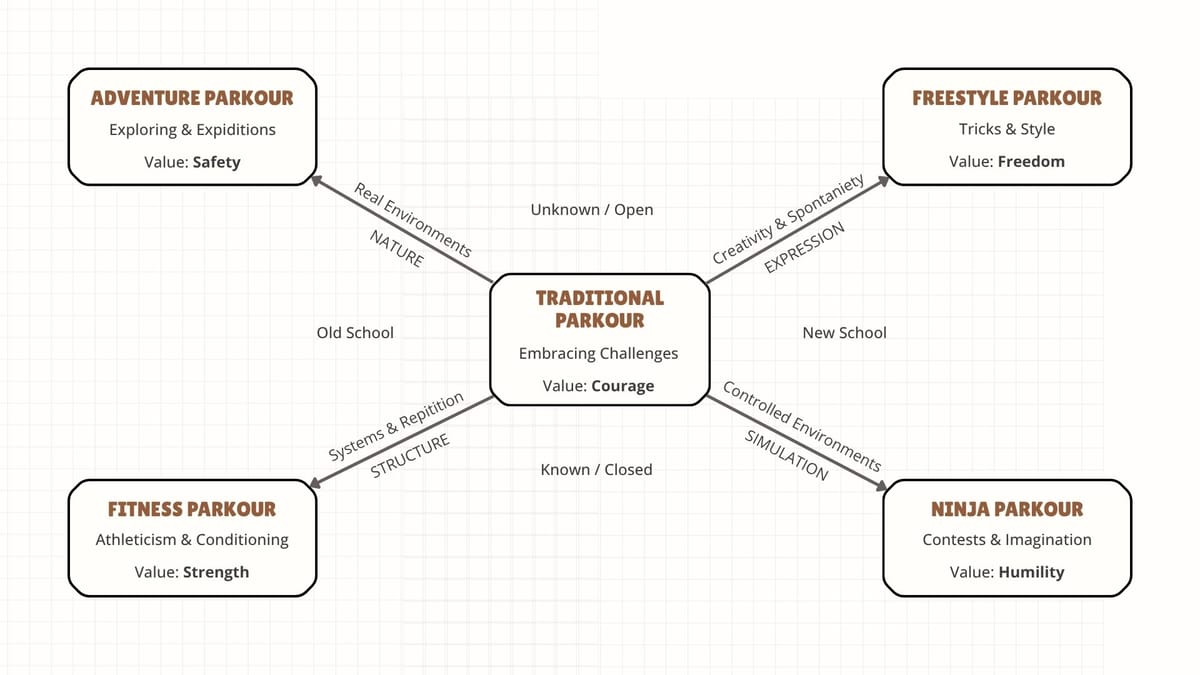
The goal here is to provide a holistic framework to clearly communicate the different types of parkour, without being too pedantic. Traditional Parkour is the heart of it in which two different spectrums intersect.
One spectrum represents natural and simulated environments, which manifests as Adventure Parkour and Ninja Parkour. The other spectrum represents structure and expression, which is expressed as Fitness Parkour and Freestyle Parkour.
The 4 different directions create complimentary types parkour which each have their own distinct attributes and values. While Adventure Parkour is exciting because the risks, Ninja Parkour is fun because it's safe. The structure in Fitness Parkour creates strength, the freedom in Freestyle Parkour gives you room for creativity.
Therefore, there are 5 types of parkour which each have different styles of their own – as well as unique teachings.
1. Traditional Parkour
This is classic parkour training, which focuses on practicing fundamental techniques to move around obstacles in the most efficient way possible. All the other types of parkour can be seen as variations or extensions of this base.
Mastering foundational movements like jumping, climbing, and vaulting, allows you to start embracing bigger obstacles. This is a good type of parkour to test your courage.
Traditional parkour is excellent at providing challenges that sit just outside your comfort zone. The basics can be practiced at many different levels, making it easy to find the right challenge to face your fears gradually. Cultivating courage is life-affirming and allows you to overcome other obstacles.
2. Freestyle Parkour
Also known as freerunning, this style of parkour incorporates flips, tricks, and expressive movement into obstacle-based training. Freestyle parkour includes a wide range of sub-styles, such as off-axis movement, tricking, gizmo, street acrobatics, and obstacle flow or “dancing.”
This is a good style of training if you want to express yourself and expand your creative freedom.
On top of teaching you how to move freely through the environment, freestyle parkour encourages freeing yourself from comparison and letting go of rigid styles in favour of personal expression.
3. Adventure Parkour
Adventure parkour is a mission-based style of training that consists of large-scale, long-distance, multi-challenge routes. Examples of these exploratory adventures include accessing rooftops, traversing under bridges, bushwhacking, and trespassing. (I do not condone illegal activities.)
This type of parkour can be incorporated into other adventure sports like hiking, bouldering, and cliff jumping. This is the type of parkour that sharpens your senses and survival instincts. It's a good style of training, if you're aware of your surroundings and practice safety.
Parkour can be dangerous, but when trained properly, it actually teaches you how to approach risk safely. Be aware of your surroundings and do safety checks of obstacles. You need to be conscious of what you are doing.
4. Ninja Parkour
Ninja parkour is simulated adventure-course training that often includes moving obstacles, tools, and lots of things to swing and climb. Ninja gyms feature ready-to-go courses that let people jump in with minimal training and provides fun mission-based challenges in a safe and structured environment.
This type of parkour is great for birthdays and date nights, or playing parkour games. This may require a bit of humility.
For beginners, parkour is harder than it looks. For advanced practitioners, it can be dangerous to show off. Parkour requires a comfort with looking goofy and being schooled by kids on the ninja course. Just have fun.
5. Fitness Parkour
Fitness parkour is the practice of obstacle movements as part of a fitness routine for strength and conditioning. This type of session can involve drilling basic movements or incorporating obstacles into a circuit.
This type of parkour is a great, if you want to get in shape or stay fit. It's also an easy way to get started, by adding new moves into your workout to build functional strength.
Parkour develops both physical power and mental resilience, which is useful in and out of training. As they say, “be strong to be useful.” It helps to be strong before starting parkour, but fitness parkour builds strength as you go.
These are the main 5 modes of practising parkour: working out, creative tricks, playing games, exploring, and focusing on the fundamentals. While it's technically possible to do reps of backflips until failure or play tag on the side of cliff, how and where parkour is trained typically leans in certain directions. What's your favourite kind of parkour session?
- Michael Jacobsen